What Do You Do About a Broken Pipe Behind a Shower Wall?
Quick answer
A broken pipe behind a shower wall needs the water shut off first: the bathroom shutoff if you can find one, or the main if not. Cut power at the breaker if water reached outlets or switches. Do not run the shower to test. Then pick access: a closet or next-room panel first, tile last. <a href="#first-steps">Jump to the steps</a>.
Key takeaways
- Shut off the water first: the bathroom shutoff if you can find one, otherwise the main (University of Illinois Extension).
- If water is near outlets, switches or circuits, cut power at the main breaker or fuse, and wait for a qualified electrician to inspect before power returns (CDC).
- EPA guidance for clean water damage aims for response within 24 to 48 hours to prevent mold growth; this window applies to clean water only.
- A next-room access panel should be at least 14 by 14 inches (Family Handyman), so shower tile can often stay in place.
- A shower valve must be pressure-balance or thermostatic with a high limit stop set to no more than 120 F (49 C), per the 2015 IRC section P2708.4; check any replacement valve against this before buying.
On this page
- What Do You Do First When a Pipe Behind a Shower Wall Breaks?
- Is It Safe to Use the Shower, the Bathroom Outlets or the Light Switches?
- Is the Broken Pipe Behind the Shower Wall in the Valve, the Riser or the Wall?
- Do You Have to Tear Out the Shower Tile to Reach a Broken Pipe?
- What Causes a Shower Supply Pipe to Break?
- Where Does the Water Show Up When a Shower Wall Pipe Leaks?
- How Fast Does Mold Start After a Shower Wall Leak?
- Can You Patch the Pipe Yourself, and When Do You Need a Plumber?
- Does Insurance Cover a Pipe Behind a Shower Wall?
- When to call a professional
- Frequently asked questions
What Do You Do First When a Pipe Behind a Shower Wall Breaks?
Shut off the water before you touch the wall: use the shutoff for the bathroom if you can find one, or the main if you cannot. Water keeps coming through the wall for as long as the supply stays on.
Know where and how to shut off your water before a pipe ever breaks, since that knowledge saves time in the moment, according to the University of Illinois Extension on water pipes.
- Shut off the water at the bathroom shutoff, or at the main if there is no bathroom shutoff.
- Stop using the shower and any fixture on the same supply line.
- Move valuables, rugs and towels out of the wet area.
- Call a plumber and contact your insurance agent.
If you are not sure this is a shower-specific break, see what to do right away when a pipe bursts for the general first-hour steps. If you cannot find a shutoff near the bathroom, learn where the main water shutoff valve is before an emergency happens.
Is It Safe to Use the Shower, the Bathroom Outlets or the Light Switches?
No. Do not use the shower, and do not touch switches, breakers or electric tools while you stand in water. If water is in or near electrical circuits, cut power at the main breaker or fuse first.
If electrical circuits or equipment have gotten wet or are in or near water, turn off the power at the main breaker or fuse on the service panel, according to the CDC guidance on electrical hazards after water damage. Never turn power on or off yourself, or use an electric tool, while standing in water.
Do not turn the power back on until a qualified electrician has inspected the equipment.
- Water near circuits or outlets: cut power at the main breaker first.
- Never flip a switch or breaker while you are standing in water.
- Wait for a qualified electrician to inspect before power returns.
Running the shower to test the leak only pushes more water into the wall, and it can expose you to scalding water from an open valve.
Is the Broken Pipe Behind the Shower Wall in the Valve, the Riser or the Wall?
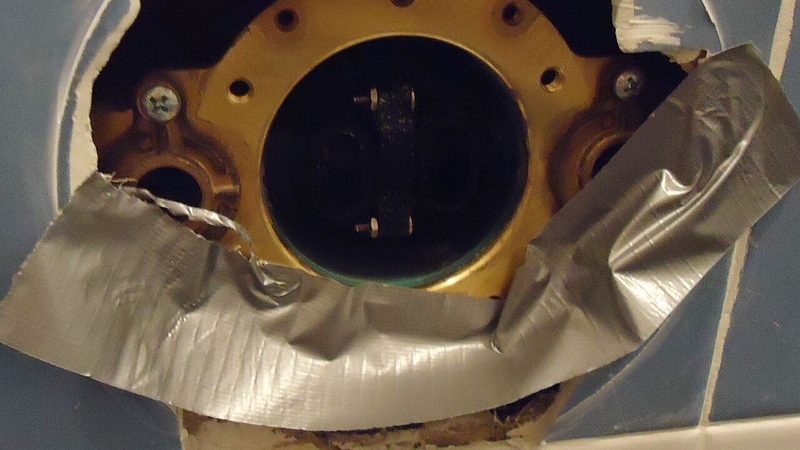
The shower takes water through a valve assembly set in the wall, with supply lines feeding it and a riser and arm carrying water up to the head. Which part broke decides the repair, so name the part before you open anything.
| Likely break point | How it tends to show | What the repair involves |
|---|---|---|
| Supply line or tee/elbow feeding the valve | Wet wall at the valve location with the shower off; water on the next room wall | Repair or replace the fitting or line section; usually needs access to the valve wall |
| Valve cartridge or valve body seal | Slow, hidden leak that shows mainly when the shower runs or at the handle | A cartridge can sometimes be swapped; a body leak may mean cutting the valve out |
| Shower riser or arm joint | Leak at the head or along the riser; water runs down the wall above the valve | Thread or joint repair; check the pipe material at the joint |
Do You Have to Tear Out the Shower Tile to Reach a Broken Pipe?
Often not. Reach the valve from the closet, the next room or behind the valve wall first, since that keeps the shower tile intact. Cut a small window in the drywall or surround next, and remove tile or the surround last.
Some homes have a removable access panel in the next room behind the faucet, and a panel that extends from stud to stud is easier to patch later (Family Handyman; Fine Homebuilding). Choose a panel of at least 14 by 14 inches, a trade recommendation rather than a code rule (Family Handyman).
| Access route | Works when | Tile and mess cost | Notes |
|---|---|---|---|
| Closet, linen space or next-room panel | The valve wall backs onto a closet or another room you can open | No shower tile lost | Panel at least 14 by 14 inches; a stud-to-stud panel is easier to patch |
| Small window cut in the shower wall | No rear access, and the leak point is narrowed to one spot | A patch of tile or board that must be re-tiled | Keep the window small; locate the break before cutting |
| Remove tile or surround | No other route to the valve | Most tile and board around the valve; full re-tile | Last resort; plan the re-tile and waterproofing first |
| From below (basement or crawlspace) | The bathroom sits over a basement or crawlspace you can reach | Little or no tile loss; ceiling below is opened | Confirm the pipe position from below before cutting |
If the break turns out to be deeper in the wall framing rather than right at the valve, see what to do when a pipe bursts inside a wall for the general in-wall steps.
What Causes a Shower Supply Pipe to Break?
The usual causes on a shower wall are an aged supply line to the valve, a cracked or stressed fitting at the valve, a failed valve seal, a loose or broken riser or arm, and freezing on an outside-facing wall. This list is the order to check, not a ranking by how often each happens.
- Aged supply line feeding the valve: check for wetness at the valve wall with no other source.
- Cracked or stressed tee or elbow at the valve: look for weeping at a joint.
- Valve cartridge or seal failure: slow and hidden, usually shows only when the shower runs.
- Riser or arm joint: leak at the head or along the riser.
- Freezing on an outside-facing wall: see below.
Can a Shower Wall Freeze If It Backs Onto an Outside Wall?
It can. Plumbing against an exterior wall is also at higher risk of freezing, according to Iowa State University Extension on frozen pipes. Freeze-prone pipes are usually near outer walls, in crawl spaces or in the attic (University of Illinois Extension).
Ask two questions: is the shower on an outside wall, and was there a cold snap before the leak? See how to keep pipes from freezing for the full prevention list.
Where Does the Water Show Up When a Shower Wall Pipe Leaks?
Shower wall water usually shows in the room on the other side of the wall, in soft or warped flooring at the threshold, or as a stain on the ceiling below. Look at each place and note what is wet and what stays dry.
| Sign | Where you see it | What it suggests |
|---|---|---|
| Water or staining on the closet or adjacent-room wall | The wall that shares the valve location | Supply or valve leak behind the wall |
| Soft or wet subfloor, or warped flooring near the threshold | Floor in front of the shower | Water has reached under the floor |
| Stain on the ceiling of the room below | Ceiling under the bathroom | Water has traveled down through the floor |
| Grout or caulk separating only at the valve wall | Tile at the valve location | Water is getting behind the tile at that spot |
| Valve wall wet while the shower pan stays dry | Shower pan and the valve wall | Points to the supply or valve, not the pan |
If the flooring is rising away from the shower itself, see water coming up through the floor for other causes to rule out.
How Fast Does Mold Start After a Shower Wall Leak?
EPA guidance for clean water damage aims for response within 24 to 48 hours to prevent mold growth. Treat that window as the target for drying, even when the wall looks dry on the surface.
The EPA guidance on clean water damage response gives guidelines for response to clean water damage within 24 to 48 hours to prevent mold growth.
This window applies to clean water only. Do not use it for sewage or dirty water; those cases need a different response.
Can You Patch the Pipe Yourself, and When Do You Need a Plumber?
Stop the flow at the shutoff first. Call a licensed plumber if you cannot locate or reach the break or the frozen section, or if a new valve must meet the code type for shower valves (Iowa State University Extension).
Do not use a blowtorch, a kerosene or propane heater, a charcoal stove or any other open flame, and never thaw a pipe with an open flame or torch.
Ask the plumber to test the repaired section before the wall is closed. This article gives no test pressure or hold time; that detail is the plumber's call.
If you want the fuller repair steps once the wall is open, see how to fix a broken pipe in the wall.
What Should a Replacement Shower Valve Match?
Check that the new valve is pressure-balance or thermostatic with a high limit stop, and that the stop is set to no more than 120 F (49 C). Individual shower valves must meet this type under the 2015 International Residential Code, section P2708.4.
A cheap in-line valve may not meet this type. Check the code edition your local jurisdiction has adopted before buying.
Does Insurance Cover a Pipe Behind a Shower Wall?
A sudden accidental discharge of water from a plumbing system is the covered type under a standard HO-3 policy, but water seepage is excluded. Call your insurance agent right after the break, and keep records of the damage.
The HO-3 covers you for accidental discharge of water from a plumbing system, according to the Triple-I on homeowners coverage for accidental discharge. Water seepage is excluded under the HO-3.
That seepage exclusion is about seepage specifically, not every slow leak, so do not assume every gradual drip is automatically excluded; ask your agent how your policy treats a sudden break versus slow seepage.
Call a plumber and contact your insurance agent after any burst (University of Illinois Extension). This is general information, not advice on your specific policy, so check your own policy wording.
For more on what a standard policy does and does not pay for after a burst, see does insurance cover a burst pipe.
When to call a professional
Call a plumber right now if you cannot find or reach the shutoff, or if water keeps flowing after you shut off both the bathroom supply and the main.
- Call a plumber if the break is at the valve, the riser or the arm, or if a frozen section is not accessible.
- Call a qualified electrician to inspect before power returns if water reached outlets, switches or circuits.
- Any replacement valve must be pressure-balance or thermostatic with a high limit stop set to 120 F (49 C) or less.
- Call your insurance agent once the water is off and the damage is documented.
Frequently asked questions
Can I use a heater or a torch to thaw a frozen shower pipe?
No. Do not use a blowtorch, a kerosene or propane heater, a charcoal stove or any other open flame, and never thaw a pipe with an open flame or torch. If you cannot find or reach the frozen section, call a licensed plumber rather than trying to force the thaw. Thawing is a slow, careful job, so the plumber decides the method once the section is located.
Should I run the shower to find where the water is coming from?
No. Running the shower puts more water into a wall that is already leaking and can expose you to hot water. Shut off the supply first, then decide on access from the options in this guide. If you need a test, leave it to the plumber, who can check the repaired section before the wall is closed.
Is a wet shower wall always a valve or supply leak, not a shower pan leak?
Not always, but the pattern helps. If the wall at the valve is wet while the shower pan stays dry, the supply or valve is the more likely source. A wet pan area with a dry wall points to the pan itself. Pan leaks need their own check, so do not treat a pan test as the same as a supply test.
Who should I call first, the plumber or my insurance company?
Call a plumber to stop the leak and repair it, and contact your insurance agent. Illinois Extension names both steps after a burst. Shut off the water first so the leak stops while you wait, and take dated photos of the wet wall and floor before anyone opens it.
Sources
- U.S. EPA, water damage table for mold prevention (clean water response window)
- CDC, What to Do to Protect Yourself From Electrical Hazards
- University of Illinois Extension, Water Pipes (disaster preparedness)
- Iowa State University Extension, Preventing and Thawing Frozen Pipes
- Insurance Information Institute (Triple-I), Am I Covered?
- Family Handyman, Shower Faucet Installation (access panel guidance)
- Fine Homebuilding, Replace a Shower Mixing Valve (stud-to-stud access panel)
- 2015 International Residential Code, Chapter 27 Plumbing Fixtures, section P2708.4 (state mirror; check the adopted local edition)