Why Did a Pipe Burst After You Turned the Water Back On?
Quick answer
A pipe bursts after the water is turned back on because pressure returns to a weak spot. One common cause is water hammer, a pressure surge from sudden changes in flow, or a pipe already cracked while frozen. Open a faucet first, open the main slowly, and shut the main off if a pipe splits.
Key takeaways
- Water hammer comes from sudden starts or stops of flow, and the pressure wave moves through water at more than 4,800 feet per second at 70 F, according to the American Society of Plumbing Engineers.
- The UK Met Office advises that with the stop tap turned off, turning on nearby cold taps relieves pressure on a frozen pipe (UK guidance).
- University of Missouri Extension advises relieving pressure by turning on a faucet, thawing a pipe at the same rate it froze, and watching for leaks from pipes frozen for several hours.
- The Maryland Insurance Administration says policies may cover the resulting water damage if frozen pipes burst, but a claim may be denied if the homeowner skipped reasonable prevention steps.
- For electric water heaters, Haier says to connect power only after the tank is confirmed full and leak free; a steady flow from the hot outlet shows the tank is full.
On this page
- Why Did My Pipe Burst After I Turned the Water Back On?
- What Is Water Hammer, and Can It Burst a Pipe?
- Can Trapped Air Cause a Leak When the Water Returns?
- How Do You Turn the Water Back On Safely?
- Should You Open a Faucet or the Main First?
- Why Does a Frozen Pipe Burst After the Water Is Turned Back On?
- Can a Weak or Cracked Pipe Stay Hidden Until Pressure Returns?
- What Should You Do Right Now If a Pipe Bursts as the Water Comes On?
- Is a Burst After Restarting the Water Covered by Insurance?
- How Do You Restart Water in a Vacant or Seasonally Closed Home?
- When to call a professional
- Frequently asked questions
Why Did My Pipe Burst After I Turned the Water Back On?
A pipe burst after you turned the water back on usually means the pipe was already weak, cracked, or frozen, and returning pressure or a sudden surge split it. Water hammer and a pipe cracked by freezing are the two mechanisms to know.
A leak that shows up the moment you open the main is different from one that appears hours later. The timing is a clue to the cause.
What the timing tells you
A bang and a leak at the exact second a valve opens points to a pressure surge. A leak with no bang, right as pressure returns, points to a joint or section that could not take full pressure.
A leak that shows up hours after a freeze points to a crack that formed while the pipe was frozen, a pattern the University of Missouri Extension describes directly.
| When the split or leak shows up | Most likely cause | First step |
|---|---|---|
| A bang at the same moment a valve opens or closes | Water hammer from a sudden flow change | Shut the main, then have a plumber check pipe straps and surge devices |
| Splits right as water pressure returns, no bang | A weak or damaged joint or section that could not take full pressure | Shut the main and call a plumber |
| Leak appears hours after a freeze or after thawing | Pipe cracked while frozen, leaks once thawed | Shut the main and call a plumber |
No source says which of these causes is most common. If you are only dealing with a drip rather than a true split, see our guide on what it means when water is still dripping after you shut off the main.
What Is Water Hammer, and Can It Burst a Pipe?
Water hammer is a pressure surge that happens when flow starts or stops suddenly. The surge travels through the pipe almost instantly. A repeating bang is a warning sign to have the system checked, even though a burst is not guaranteed.
What starts the surge
According to the American Society of Plumbing Engineers explainer on water hammer, the most frequent cause of water hammer is a valve closed abruptly, which stops flow suddenly. Opening a valve suddenly carries the same risk, since the source describes flow starting or stopping.
How fast the surge travels
The pressure wave moves through the piping at the speed of sound in water, more than 4,800 feet per second at 70 F, according to ASPE. That is faster than you can see, which is why the stress on a fitting can happen before anyone notices a leak.
Some references advise keeping flow velocity at or below 5 feet per second to keep the risk of water hammer low. This is a general plumbing-design guideline, not a code or a homeowner rule, so treat it as context rather than a number to measure yourself.
Devices that absorb a surge
ASPE lists expansion tanks, surge vessels, accumulators, and air chambers partly filled with gas or air as the devices used to reduce a surge. A plumber can add or service these.
We cannot say a surge always bursts a pipe, but a strong surge can stress joints and fittings over time, which is our general reasoning rather than a sourced claim. A repeated bang is still worth the call described in our guide on the banging and noises that can come before a burst.
Can Trapped Air Cause a Leak When the Water Returns?
Air in the lines may add to a surge, and some plumbing guides say so. We could not confirm this from a primary source, so treat trapped air as a possible contributor, not a proven cause.
The only confirmed fact about air in a pipe system comes from ASPE's description of surge devices: air chambers and surge vessels are partly filled with gas or air on purpose, to absorb shock. That is a designed feature, not evidence that ordinary trapped air causes a burst.
Our general advice: a bang that repeats after you restart the water can point to an air chamber that is waterlogged or missing. A plumber can check this. We do not give a step for releasing air from one specific faucet, since no primary source confirms an order that works for every house.
How Do You Turn the Water Back On Safely?
Check the house first, open the main slowly, open fixtures one at a time, and watch for bangs and drips at each step. Do not force a stuck valve. Stop and call a plumber if anything leaks or bangs.
- Look for visible drips or wet spots at the main, meter, and any fittings you can reach before you open anything.
- Confirm every fixture is closed, then open the main slowly. Our general advice, based on the fact that sudden starts of flow cause water hammer.
- Open one cold faucet at a time and let flow settle before you open the next. This order is our general advice, not a sourced sequence.
- Walk the house and check each fixture, supply line, and the water heater for drips before you move on.
- If you hear a bang, see a drip, or a valve will not turn smoothly, close the main at once and call a plumber.
Electric water heater: wait until the tank is full
According to Haier guidance for electric water heaters, connect the power supply only after confirming the tank is full and leak free. A steady flow from a hot outlet shows the tank is full. This rule is for electric units; gas units are not covered by this source, so check your own manual.
Do not force a stuck valve
If a valve is stuck, stop and call a plumber rather than forcing it, which is our general safety advice. We do not give a turning direction for the valve, since guidance conflicts across sources and no primary source confirms one direction for every valve type.
If you are not sure where your main valve is, see how to find and close your main shutoff valve before you start. The UK Met Office advice on frozen or burst pipes also recommends knowing where your stop tap is and checking that it works every six months (UK guidance).
Should You Open a Faucet or the Main First?
University of Missouri Extension advises turning on a faucet to relieve pressure in the line, and the UK Met Office advises turning on nearby cold taps with the stop tap off. Open the main slowly, since sudden starts cause water hammer. No primary source gives one fixed order for every house.
| Action | Context | Source status |
|---|---|---|
| Open a faucet to relieve line pressure | Thawing a frozen line | University of Missouri Extension, confirmed |
| Open nearby cold taps with the stop tap off | Frozen pipe, UK guidance | Met Office, confirmed for the UK |
| Open the main slowly | Avoid sudden flow starts | ASPE mechanism, our general inference |
The faucet step above is shown for thawing a frozen line, not as a general restart rule for every situation. A fixed, universal restart order is not confirmed by any primary source we found. We do not give a psi number, a timing number, or a utility's gradual turn-on quote, because none of those is confirmed.
Why Does a Frozen Pipe Burst After the Water Is Turned Back On?
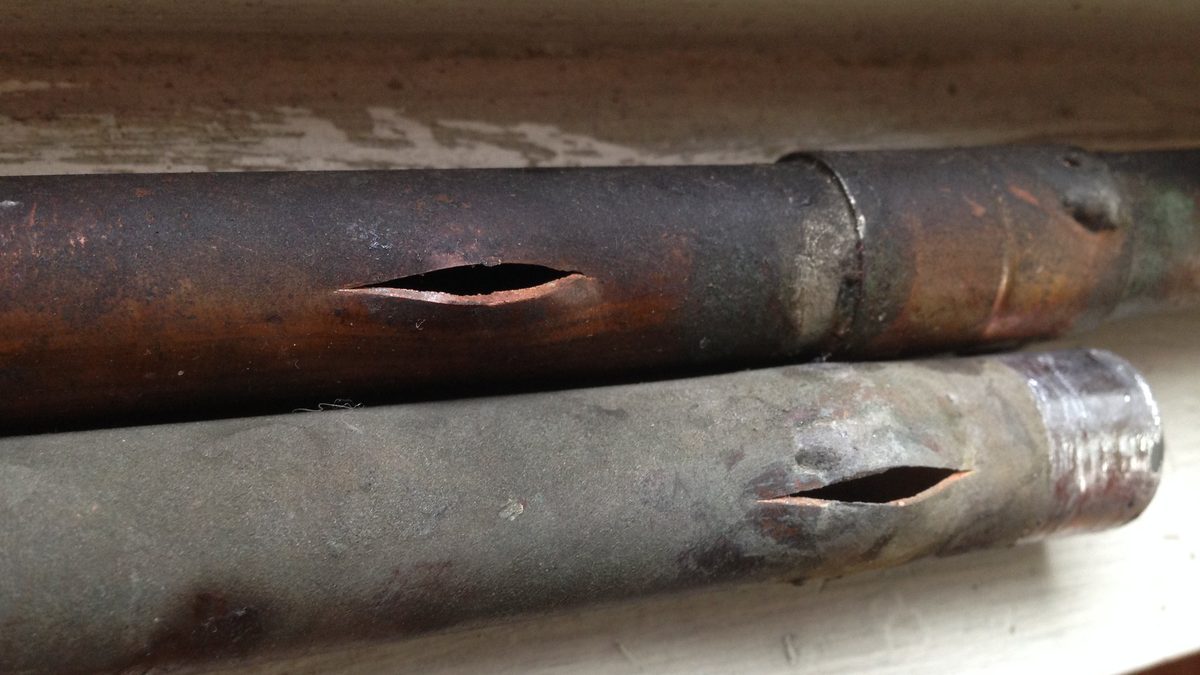
A frozen pipe can crack while the ice blocks it, and the crack shows up when water and pressure return or the ice melts.
The University of Missouri Extension advice on thawing frozen pipes says to thaw the pipe at the same rate it froze, so it does not get damaged, and to be ready for leaks from pipes frozen for several hours.
Why the thaw rate matters
University of Missouri Extension states the object is to thaw the pipe at the same rate that it froze, so it does not damage the pipe. Our general reading of that advice: thawing too fast is the risk, since the rate itself is what the source calls out.
Leaks that show up hours later
The same source advises being prepared for leaks from pipes that have been frozen for several hours, and notes that pipes may have cracked and can leak once they are thawed.
Tell yourself the leak may appear later, not only at the moment of restart. For the first-hour steps specific to a freeze, see our guide on the first-hour steps for a pipe that froze and burst; we do not repeat them here.
What Should You Do Right Now If a Pipe Bursts as the Water Comes On?
Shut off the main at once, keep people and electricity away from the wet area, open a faucet to drain the line, and call a plumber. Do not wait for the leak to stop on its own.
- Close the main shutoff valve at once.
- If water is near outlets, a light fixture, or an appliance, turn off power at the breaker only if you can do it without standing in water. This is our general safety advice.
- Open a faucet to drain the line and reduce pressure, which lines up with the pressure-relief step University of Missouri Extension describes for a frozen line.
- Put a bucket or towels under the leak and move valuables out of the wet area.
- Call a plumber. Keep your photos and notes for insurance.
The UK Met Office advises turning off your inside stop tap immediately if you spot that a pipe might be frozen (UK guidance). We do not give a time limit for how long a leak can run before damage sets in, since no source confirms one.
For the general first-hour steps when any pipe bursts, see the general first-hour steps when a pipe bursts.
Is a Burst After Restarting the Water Covered by Insurance?
It can be. This is general information, so check your own policy. The Maryland Insurance Administration guidance on frozen pipes says policies may cover the resulting water damage if frozen pipes burst, but a claim can be denied if the homeowner did not take reasonable prevention steps.
The Maryland guidance is written about frozen pipes specifically. It does not say whether a surge or water-hammer burst is treated the same way, so for a burst that was not caused by freezing, check your own policy wording rather than assuming the frozen-pipe rule applies.
The same source lists prevention steps insurers may expect, such as allowing a slight drip from faucets and opening cabinet doors under sinks during cold weather.
We do not give coverage amounts, deductibles, or claim timelines, since none of those is confirmed for this topic. See what homeowners insurance covers after a burst pipe for the broader coverage picture.
How Do You Restart Water in a Vacant or Seasonally Closed Home?
Confirm the supply was shut off while the home was empty, check the stop tap works, then restore water slowly, one fixture at a time, watching for leaks at each step and at the water heater. Use the power rule for electric water heaters.
- Confirm the main was off while the home was empty, and that the stop tap closes. The Maryland Insurance Administration advises shutting off the water supply when a home is vacant.
- Check that every supply line and fixture connection is in place and tight before you open the main. This is our general advice.
- Open the main slowly, then open one fixture at a time and check for drips at each one.
- Fill the water heater tank first. Turn on electric power only after the tank is full and leak free, per Haier's guidance for electric units.
The UK Met Office also advises knowing where your stop tap is and checking it works every six months (UK guidance), a habit worth keeping for a vacant home too.
For year-round prevention steps for an empty house, see our guide on freeze prevention for an empty house. We do not give a number of days or hours a home must be empty before this guidance applies.
When to call a professional
Call a plumber now if any of these apply:
- Water is spraying or pooling from a split pipe. Close the main first, then call now.
- A leak is still running after you close the main, or a leak returns after you reopen the water.
- A valve is stuck, seized, or leaks when you turn it.
- A bang repeats each time a valve opens or closes, even after you check the pipe straps. A plumber can check or add a surge device, such as the air chambers or surge vessels ASPE describes.
- A plumber's gauge reads high static pressure. Ask about a pressure-reducing valve. We do not give a psi number, since none is confirmed.
- There is no hot water after the restart, or an electric water heater's tank is not yet full. Do not power an electric unit on until it is full, per Haier.
- You suspect a pipe froze and burst. Shut the inside stop tap immediately (UK Met Office guidance) and call.
Frequently asked questions
If the utility shut off the water and a pipe burst after it was restored, who is responsible?
We could not confirm from a primary source where the line between the utility and your home falls. Check your utility's website or call them, and check your policy. Write down the date and time of the shutoff and restore, any utility work nearby, and take photos of the break before you move anything.
Should I check water pressure before restarting, and what pressure is too high?
A plumber can measure static water pressure with a gauge. A high reading is a reason to ask about a pressure-reducing valve. We do not give a pressure number, because we could not confirm a limit from a primary source, and local plumbing code sets the requirement.
Will my electric water heater be damaged if I turn the water on before the tank is full?
Manufacturer guidance for electric water heaters is to never power the unit when it is empty or short of water. Connect power only after the tank is confirmed full and leak free. A steady flow from a hot outlet shows the inner tank is full. This applies to electric units; check your own manual for gas units.
Should I call a plumber to restart the water, or can I do it myself?
For a normal restart with no leaks, many homeowners can do it carefully, one fixture at a time. Call a plumber if a valve is stuck, if a leak appears after the main is back on, if a bang keeps repeating, or if the water heater gives no hot water after the restart.
How long should I wait after thawing a frozen pipe before turning the water on?
We could not confirm a fixed waiting time from a primary source, so do not treat any number as a rule. Thaw the pipe slowly with a faucet open, as University of Missouri Extension advises. After you restore water, stay near the pipe and check it, because leaks can show up hours later.
Sources
- American Society of Plumbing Engineers (ASPE), Plumbing 101: Breaking Down the Water Hammer Phenomena
- UK Met Office, Frozen or burst pipes (seasonal advice for your home; UK)
- University of Missouri Extension, MU expert recommends precautions to avoid frozen pipes
- Maryland Insurance Administration, Frozen Pipes (consumer guidance)
- Haier, electric water heater self-service support page (manufacturer guidance)