Why Is Water Still Dripping After You Shut Off the Main?
Quick answer
Water that is still dripping from faucets after you shut off the main valve is normal for the first several minutes while residual water drains out under gravity. If dripping continues past 30 minutes with the lowest and highest faucets open, your shut-off valve likely has a problem and needs repair. Close valves slowly to avoid water hammer.
Key takeaways
- Residual water trapped in the pipes normally drains within 5 to 10 minutes once you open the lowest and highest faucets together, a technique plumbing contractors recommend.
- Dripping that continues past 30 minutes with both faucets open signals a faulty shut-off valve, usually from worn seals, mineral buildup, or corrosion.
- Closing a valve too quickly causes water hammer, a pressure spike that can exceed 100 psi above normal system pressure, according to Valve Magazine.
- Replacing a main shut-off valve costs $200 to $600 including labor, while the valve itself runs only $15 to $60, according to CosttoRenovate and Forbes.
- Mold can begin growing within 24 to 48 hours on wet materials, per the EPA, and standard homeowners insurance covers sudden burst-pipe damage but not gradual leaks, per Travelers.
On this page
- Is It Normal for Water to Still Drip After Shut Off?
- Why Is Water Still Dripping Out After You Shut Off the Valve?
- How to Stop Water from Dripping: First Steps
- Signs Your Shut-Off Valve Is Broken or Failing
- Types of Main Shut-Off Valves and Their Leak Patterns
- Water Hammer and Other Safety Concerns
- When to Call a Professional Plumber
- Main Shut-Off Valve Replacement Cost
- When to call a professional
- Frequently asked questions
Is It Normal for Water to Still Drip After Shut Off?
Yes, a brief drip after you close the main valve is normal. Pressure drops the instant the valve shuts, but the water still sitting inside the pipes has to drain out by gravity, which takes a few minutes.
How the Drainage Process Works
When you close the main valve, the pressure pushing water through the pipes disappears immediately. The water already inside the lines keeps moving downhill until it reaches the lowest open faucet, according to a JustAnswer plumbing Q&A thread on the topic.
Opening the lowest faucet in the house and the highest faucet at the same time speeds this along, a technique plumbing contractors recommend in a Guild Quality Q&A. Air enters from the top while water drains from the bottom, and the lines are typically empty within 5 to 10 minutes in most homes.
Why Pressure Drops Faster Than Water
Pressure is what pushes water through a pipe. The instant the valve seats, that push is gone, but the water trapped between the valve and every faucet in the house still has to drain out somewhere.
That is why a sink on the top floor can keep dripping for a minute or two after a basement sink has already stopped. The water is draining downhill, fixture by fixture, not all at once.
| Scenario | What you will see | Total drain time |
|---|---|---|
| Main valve just closed, faucets untouched | Slow dripping for 2 to 5 minutes | 5 to 10 minutes |
| Lowest and highest faucets opened together | A faster initial flow that tapers off | 5 to 10 minutes |
| Valve problem present | Dripping or flowing continues despite open faucets | 30+ minutes, or never stops |
If you came here because a pipe actually split rather than just dripping after shutoff, see what to do when a pipe bursts for the full first-hour response. Drying after water damage should start as soon as the leak is fully stopped, since every extra wet hour adds to the cleanup.
Why Is Water Still Dripping Out After You Shut Off the Valve?
When you close the shut-off valve, water pressure disappears instantly, but gravity still has to pull the leftover water out of the pipes. Until the lines are empty, any open faucet below the system's highest point will keep dripping.
The Role of Water Pressure vs. Gravity
Water pressure, not gravity, is normally what pushes water out of a faucet when you turn it on. Shutting the main valve cuts off that pressure source immediately, according to McCullough Air Conditioning's plumbing team.
Gravity takes over from there, and gravity moves much slower than pressurized water. That difference between instant pressure loss and slow gravity drainage is why the faucet keeps dripping.
Why Dripping Continues Without Proper Drainage
If you only close the main valve and never open a faucet, trapped air pockets can form inside the pipes. These pockets slow drainage and can make a faucet drip on and off for longer than the normal 5 to 10 minutes.
Opening both the lowest and highest faucets, as described in the steps below, breaks up those air pockets and lets the system drain evenly instead of in fits and starts.
Not every mystery leak is a valve problem. If you are also wondering why pipes burst in the first place, the causes are usually different from a worn valve seal, more often freezing, corrosion, or a sudden pressure spike.
If you cannot find your home's main shut-off valve in the first place, confirm its exact location now. See how to find your main shut-off valve so you are not searching for it during a real emergency.
How to Stop Water from Dripping: First Steps
Open the lowest faucet in your home and the highest faucet at the same time. Air enters from the top while water drains from the bottom, and the dripping typically stops within 5 to 10 minutes.
Why You Need Both Lowest and Highest Faucets Open
A single open faucet can trap air behind the water column and slow drainage to a crawl. Opening the lowest and highest faucets together is the standard drainage technique plumbing professionals recommend, according to a Guild Quality contractor Q&A.
Air moves in through the high faucet as water moves out through the low one, which keeps the whole line draining steadily instead of stalling partway through.
| Step | What to do |
|---|---|
| 1 | Locate the main shut-off valve and close it fully: turn a lever a quarter turn, or a wheel clockwise until it stops. |
| 2 | Go to the lowest faucet in the house, often a basement sink or utility spigot, and turn it fully on. |
| 3 | Go to the highest faucet, often an upstairs bathroom or attic fixture, and turn it fully on too. |
| 4 | Leave both faucets open and let the system drain completely. This usually takes 3 to 10 minutes. |
| 5 | Once dripping stops completely at both faucets, turn off the highest one first, then the lowest. |
How Long to Wait Before Everything Stops
Give the system a full 10 minutes before you decide something is wrong. Most homes finish draining in 5 to 10 minutes, so if both faucets run dry within that window, you are done.
If dripping is still steady after 30 minutes with both faucets open, stop waiting. That points to a valve problem rather than normal residual water, covered in the next section.
Signs Your Shut-Off Valve Is Broken or Failing
A broken shut-off valve keeps dripping or flowing well past the normal drainage window. Watch for dripping that continues after 30 minutes, forceful flow despite the valve being closed, visible corrosion, or a handle that will not turn.
Common Causes of Valve Failure
Mineral and sediment buildup inside the valve body is the most common cause. It keeps the ball or gate from seating fully closed, according to Armadillo's plumbing resources.
Rubber seals inside the valve also warp or wear out with age, which lets water seep past even when the handle is fully closed, according to Integrity Plumbing.
A valve that sits untouched for years is actually more likely to fail than one used regularly, since its internal parts can corrode or fuse in place over time, according to Liberty Home Guard.
Visual Inspection Steps
Look for green or white crust around the valve body, a sign of corrosion or mineral deposits. Feel for dampness on the pipe just past the valve, and try the handle gently; it should move without excessive force.
| What you notice | Likely cause | Urgency |
|---|---|---|
| Dripping continues after 30+ minutes with faucets open | Worn seals or incomplete closure | High: call a plumber soon |
| Water flows with force despite the valve being closed | Gate or ball not sealing, possible internal damage | Immediate: stop using water, call a plumber |
| Visible corrosion, rust, or mineral deposits | Corrosion or mineral buildup inside the valve | High: plan replacement within days |
| Handle is stuck or very hard to turn | Corrosion, sediment, or internal damage | High: do not force it, call a plumber |
A valve that fails quietly for weeks can soak framing and flooring before anyone notices, which is why finding hidden water leaks early is worth the effort even when nothing looks obviously wrong. If damage has already happened, repair costs depend heavily on how long the area stayed wet.
Types of Main Shut-Off Valves and Their Leak Patterns
The three common types are ball valves, gate valves, and diaphragm valves. Each one fails in a different way, so knowing which type you have helps explain the leak pattern you are seeing.
How to Identify Your Valve Type
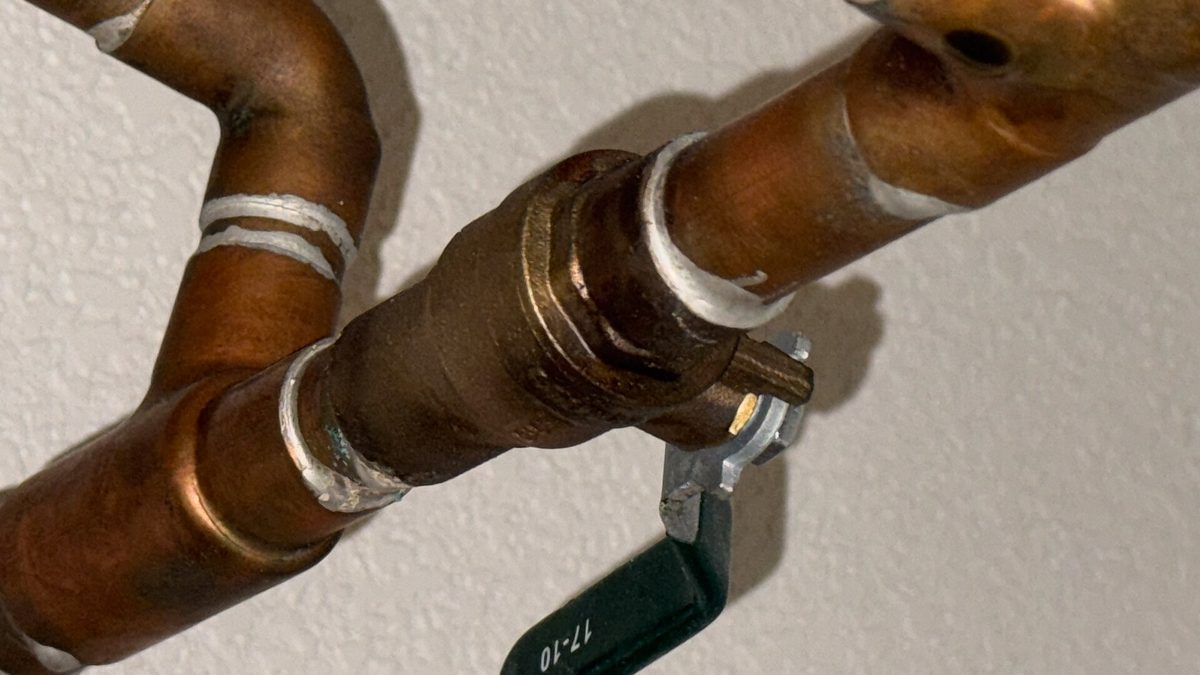
A single straight lever handle means a ball valve, the type most commonly used as a home's main shutoff, according to Family Handyman. A round wheel handle that takes several turns to close means a gate valve, more common in older homes.
A diaphragm valve uses a lever or screw handle and a flexible rubber diaphragm instead of a ball or gate. These show up less often, mostly on older fixtures.
| Valve type | Handle | Typical leak pattern | Root cause |
|---|---|---|---|
| Ball valve | Single lever, crosswise to the pipe when closed | Steady small drips despite a fully closed handle | Worn seals or mineral scale on the ball |
| Gate valve | Screw-down wheel, several turns to close | Slow drip that can worsen if only partly closed | Stuck gate, corrosion, mineral buildup |
| Diaphragm valve | Lever or screw handle | Gradual seeping around the valve body | Cracked or deteriorated diaphragm |
If the leak you are chasing is actually coming from a water heater's own shutoff rather than the home's main valve, that is a separate set of causes beyond the scope of this guide.
Water Hammer and Other Safety Concerns
Water hammer is a sudden pressure spike that happens when you close a valve too fast. It can exceed 100 psi above your system's normal pressure and damage pipe joints, seals, and connected equipment.
How to Avoid Water Hammer
Close the main valve slowly and steadily rather than snapping it shut. A valve closed in under half a second can generate a pressure spike of more than 100 psi above normal operating pressure, according to Valve Magazine.
That spike can reach five times or more the system's normal pressure, enough to fatigue pipe joints and accelerate wear on a water heater, washing machine, or filtration system, according to Norgren's engineering guidance.
When to Leave Your Home
Leave immediately if you smell gas, see water near an electrical panel or outlet, or notice a ceiling or floor sagging under standing water. These hazards outrank any plumbing concern.
| Hazard | Pressure spike | Potential damage |
|---|---|---|
| Quick valve closure | 100+ psi above normal operating pressure | Burst small pipes, damaged seals, strained joints |
| Repeated water hammer over time | Cumulative wear | Accelerated wear on water heaters and washing machines |
| Water spray near an electrical panel | Not applicable | Electrical shock or short circuit risk |
When to Call a Professional Plumber
Call a plumber right away if water does not slow down after 30 minutes of open faucets, if it sprays rather than drips, if you see corrosion on the valve, or if the handle is stuck.
Each of these signals a valve that cannot simply be adjusted and needs professional replacement before it causes real water damage.
What Happens When You Call
A plumber will confirm whether the valve itself has failed or whether the leak is coming from somewhere else, such as a fixture supply line. If the valve needs replacing, they can usually isolate the line at the street or meter so your water stays off safely during the repair.
Temporary Fixes While Waiting for the Plumber
Keep a bucket or towels under the drip and check them periodically so they do not overflow. Do not force a stuck handle; a cracked valve body is harder and more expensive to fix than a slow drip.
| Condition | Action |
|---|---|
| Water still drips or flows after 30 minutes with both faucets open | Call a plumber the same day or next morning |
| Water sprays or flows with force from a closed valve | Call immediately; shut off water at individual fixtures if possible |
| Visible corrosion, rust, or pooling around the valve | Call within 24 hours |
| Handle is stuck, cracked, or hard to turn | Do not force it; call the same day |
| Valve is soldered to copper pipe rather than threaded | Call for professional replacement |
| You cannot find or identify your shut-off valve at all | Call a plumber to locate and label it |
If the valve failure already let water escape into walls or flooring, mold can begin growing within 24 to 48 hours on wet materials, according to the EPA. Water sitting that long can also shift from a clean Category 1 loss to a dirtier Category 2 loss under IICRC S500 guidelines, which affects both drying time and your insurance claim.
Whether the resulting damage is covered depends on your policy; see does insurance cover a burst pipe for what is typically included.
For ongoing prevention once this valve is fixed, the broader habits for preventing burst pipes year round cover the same root causes: age, corrosion, and neglect.
Main Shut-Off Valve Replacement Cost
Replacing a main shut-off valve typically costs $200 to $600 including labor, averaging around $375, according to CosttoRenovate. The valve itself costs only $15 to $60, according to Forbes; the rest pays for a plumber's time isolating the line and testing for leaks.
Why Labor Is Most of the Cost
Reaching the valve safely, shutting down the system, and confirming a watertight seal afterward takes far more time than the valve itself costs. An indoor valve that is easy to reach runs $300 to $600, according to CosttoRenovate.
A valve that is buried, boxed, or hidden behind a finished wall can push the total to $500 to $1,200, according to the same source, since reaching it means cutting into drywall or flooring first.
| Location | Labor complexity | Typical cost |
|---|---|---|
| Indoor, accessible basement or crawlspace | Low | $300 to $500 |
| Indoor, inside a wall or under flooring | High | $600 to $1,000 |
| Buried or outside near the meter | Very high | $800 to $1,200 or more |
Will Insurance Cover This?
No, standard homeowners insurance treats valve replacement as routine maintenance and does not cover it. If the failing valve caused sudden water damage to walls, flooring, or belongings, that resulting damage is typically covered as a sudden loss, according to Travelers.
Gradual leaks and damage that built up over time are usually excluded, so document the date you first noticed the problem. If the repair turns into a bigger job, compare burst pipe repair costs for what a full pipe replacement adds on top of the valve itself.
When to call a professional
Call a plumber right away if any of these apply:
- Water still drips or flows after 30 minutes with the lowest and highest faucets open.
- Water sprays or flows with force despite the valve being fully closed.
- You see corrosion, rust, or pooling water around the valve body.
- The valve handle is stuck, cracked, or will not turn.
- Standing water or wet materials are already present, since mold can begin growing within 24 to 48 hours.
Frequently asked questions
How long does it really take for the water to stop dripping?
With the correct technique, opening the lowest faucet in the house and the highest faucet at the same time, water normally stops dripping within 5 to 10 minutes. If dripping or flowing continues after 30 minutes despite both faucets being open, your shut-off valve is likely faulty and needs a plumber's attention soon.
Can I fix a leaking shut-off valve myself?
Most shut-off valves cannot be repaired by a homeowner. Once internal seals wear out or mineral buildup blocks the ball or gate from closing fully, replacement is the only reliable fix, since attempting a DIY repair often cracks the valve body and makes the leak worse.
What should I do if my valve is stuck and won't turn?
Do not force a stuck valve, since excess force can crack the handle or snap internal parts, leaving you with no way to shut off water at all. Call a plumber instead. They have specialized tools to free a stuck valve, or they can recommend replacement if it is too corroded to save.
If water damage occurred from a failing valve, how quickly does mold grow?
Mold can begin growing within 24 to 48 hours on wet materials in warm, humid conditions, according to the EPA. This is why professional water extraction and drying in the first 12 to 24 hours after any leak or burst pipe matters so much for limiting damage and repair costs.
Does homeowners insurance cover the cost of replacing my shut-off valve?
No, standard homeowners insurance treats valve replacement as routine maintenance and does not cover it. If the valve failure caused sudden water damage to walls, flooring, or belongings, that resulting damage is typically covered as a sudden loss, though you should always confirm details with your own policy.
What is water hammer and why is it dangerous?
Water hammer is a pressure surge caused by closing a valve too quickly. It can create spikes exceeding 100 psi above your system's normal operating pressure, enough to damage pipe joints, seals, and appliances like water heaters. Always close your main valve slowly and steadily to avoid triggering it.
Sources
- JustAnswer, Plumbing Q&A on Water Draining After Main Valve Shutoff
- Bob Vila, How to Turn Off Water to Your House
- Guild Quality, Contractor Q&A on Drainage Time After Main Shutoff
- Family Handyman, Types of Water Shut-Off Valves
- Valve Magazine, Water Hammer
- CosttoRenovate, Main Shutoff Valve Replacement Cost Guide
- Forbes Home, Main Water Shut-Off Valve Cost
- Travelers, Does Homeowners Insurance Cover Burst Pipes
- US EPA, A Brief Guide to Mold, Moisture and Your Home