What Do You Do When a Pipe Bursts Under Your Driveway?
Quick answer
A pipe burst under the driveway needs three things now: shut off the water at the house valve, keep cars and people off the wet or soft ground, and call a licensed plumber and your water utility. Look for a wet patch that will not dry or a meter that keeps moving with all water off. <a href="#first-steps">Jump to the steps</a>.
Key takeaways
- Shut off the water at the house valve first. Every minute the line keeps running sends more water into the ground under the pavement.
- Wait 30 minutes with all water off, then check the meter dial. If it moved, you likely have a leak, per the East Bay Municipal Utility District's meter test.
- A line on private land is often not marked by 811. NC811 says water lines are marked only within the right of way or to the meter, so a private segment often needs a paid private locator.
- Who pays depends on where the break sits. One Michigan township's rule makes the line from the property line to the house the owner's and the meter the utility's; check your own utility's rule.
- Cities can limit cutting new pavement. Fernley, Nevada adopted a five-year moratorium on non-emergency cuts in newly built, resurfaced, or reconstructed streets.
On this page
- What Do You Do First When a Pipe Bursts Under Your Driveway?
- Is It Safe to Park or Drive on a Driveway Where a Pipe Burst?
- How Do You Tell Whether the Break Is Yours or the Utility's?
- Do You Need to Call 811 Before Digging Up Your Driveway?
- Does a Pipe Under the Driveway Have to Be Dug Up?
- Do You Need a Permit to Dig Up Your Driveway?
- What Drives the Cost of Fixing a Pipe Under the Driveway?
- Does Insurance Cover a Driveway Tear-Out?
- When to call a professional
- Frequently asked questions
What Do You Do First When a Pipe Bursts Under Your Driveway?
Shut off the water at your house shutoff valve first. Then keep people and vehicles off the wet or soft ground, and call a licensed plumber and your water utility.
- Shut off the water at the house shutoff valve. If you cannot find it, see how to find and shut off your house water valve.
- Keep people and vehicles off the wet or soft area. The next section explains when it is safe to park there again.
- Keep water away from electrical outlets, panels, and running appliances. If water reaches them, stay clear and call an electrician.
- If the wet area smells like sewage, treat it as a sewage problem, not a clean water leak.
- Call a licensed plumber and your water utility. Ask each one which section of pipe it will repair.
- Photograph the wet area, the pavement, and any damage before cleanup. Keep the photos for your insurer.
Is It Safe to Park or Drive on a Driveway Where a Pipe Burst?
Not while the ground is wet, soft, sinking, or cracking. Move vehicles and keep people off the suspected area until a plumber confirms the ground is firm.
For the general outdoor burst-pipe steps and the broader sinkhole question, see our guide on pipe bursts outside the house. This section covers only the driveway-specific parking and driving call.
| Level | What you see | What to do |
|---|---|---|
| Clear | Dry, firm ground, no water showing | Park and walk as usual |
| Watch | A wet patch that does not dry, or water at the pavement edge, but the ground still feels firm | Move the car off the area and keep it off until checked |
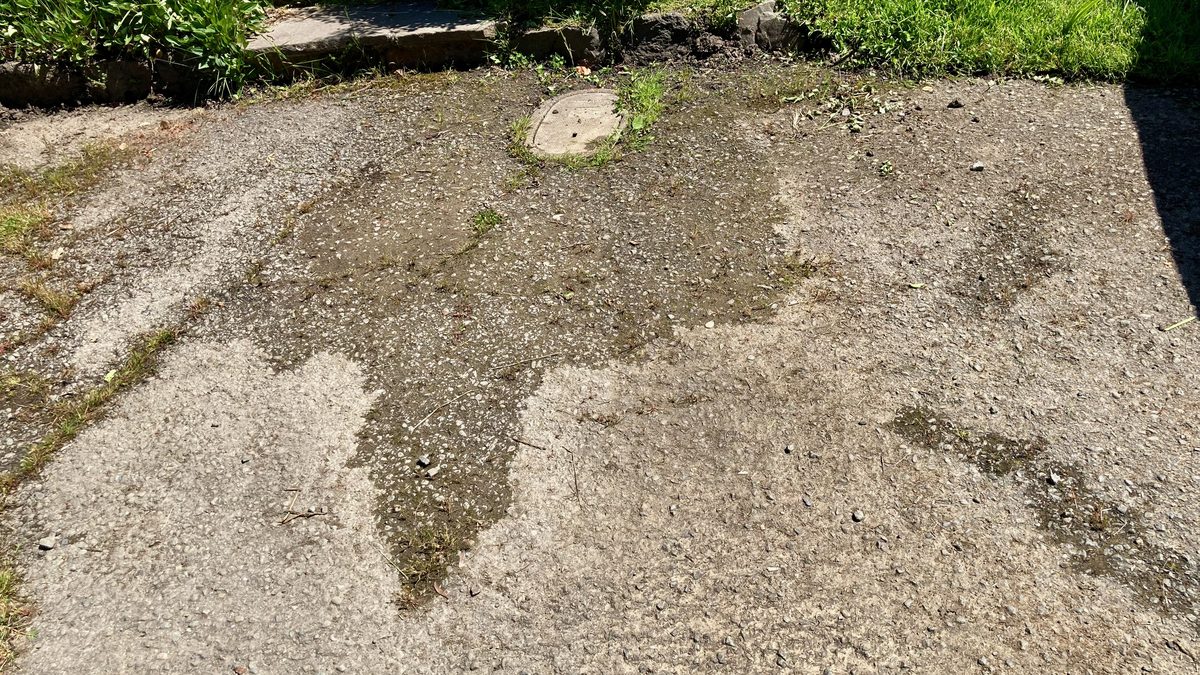
| Leave | Water spraying up through the pavement, pooling and spreading, a soft or spongy spot, sinking or a dip, new cracks or a gap at the edge, or a hollow sound underfoot | Move everyone and every vehicle away now and call the utility |
This three-level rule is our own precaution, not a published standard. We did not find a confirmed weight limit for ground that may have washed out underneath, so treat any Leave sign as a reason to stay off the area.

How Do You Tell Whether the Break Is Yours or the Utility's?
It depends on where the break sits compared with your property line and meter, and on your utility's rules. A simple meter test tells you which side of your house shutoff the leak is on, which points you toward who is likely responsible.
The average household's leaks can account for more than 9,300 gallons of water wasted every year, according to the U.S. EPA. A meter dial that keeps moving is worth acting on right away.
Which Side of the House Valve Is the Leak On? (the meter test)
Use this three-step test, based on the East Bay Municipal Utility District's method, to narrow down the leak.
- Turn off all water in and around the house.
- Wait 30 minutes without using any water, then check the meter dial. If the dial has moved, you likely have a leak.
- Turn off the house shutoff valve, mark the dial, and wait 30 minutes again.
If the dial still moves with the house valve off, the leak is likely in the pipe between the meter and the house, usually the segment under the driveway. If the dial does not move, the leak is likely inside the home.
One Utility's Example: The Owner's Line From the Property Line to the House
Rules differ by utility, so check yours in writing. Brighton Charter Township in Michigan states that the portion of the water service "from the property line to and within the residence is owned by the Customer."
The same page says residential meters are "furnished, owned, and maintained" by the township, but leaks in the customer's service pipe "must be repaired immediately by the Customer and at the Customer's expense." The page does not cover the section between the main and the property line, so ask your own utility about that part.
- Break on the street side of your property line: ask the utility; the rule is usually theirs.
- Break between the property line and the meter: check your utility's rule and ask in writing.
- Break between the meter and the house, under the driveway: in the Brighton example above, this section is the owner's. See our guide on what to do when the break is on the main side of the meter if your test points the other way.
If the meter test points to a break right where the line enters the house, that is a related situation with its own entry point and fix. This article does not cover that case in detail.
If you have no sudden burst, only a wet patch or a rising bill that comes and goes, that points to a slower, ongoing underground leak. That is a different diagnosis question from the active burst covered here, and the signs of a slower leak under a driveway are covered separately.
Do You Need to Call 811 Before Digging Up Your Driveway?
Call 811 or your state's one-call center, but do not assume it will mark the pipe on your land. Many centers mark public lines only, so a private line under your driveway often needs a private locator.
- Call 811 or your state's one-call center now. Notice time differs by state; Michigan's MISS DIG asks for at least 3 business days before excavation on your property, so ask yours.
- Ask which segment the utility will mark. NC811 says water lines "are only marked within the right of way or to the meter, and not on private property."
- Hire a private locator for the private segment. NC811 says "you will need to pay a private line locator to locate lines on private property."
Even in an emergency, call now and ask the utility what it will mark and when a crew can reach the meter.
Does a Pipe Under the Driveway Have to Be Dug Up?
Sometimes. A plumber may repair from an access point, reline the old pipe, or re-route the line above ground. If none of these fit, the pavement must be cut and broken to reach the pipe.
| Option | When it may fit | What to ask |
|---|---|---|
| Access point or spot repair | The break is near a reachable point | Can the crew reach it without opening the whole run? |
| Lining or no-dig repair | The existing line can carry a liner | Can the crew do this without breaking the pavement? |
| Re-route above ground | A new path can avoid the driveway | What approval, separate permits, or landscaping impact does this add? |
| Break out and patch | None of the above options fit | Ask for the saw-cut plan, the finish match, and the cure time before driving |
A plumbing contractor's own description of this job is that it "will typically include excavation," and that the concrete "needs to be broken and the underlying pipeline fixed or replaced." In another contractor's words, trenchless work is "usually fast once access and utilities are clear," though no source we checked gives a set duration.
See our guide on how a burst pipe repair is usually done for the general process. If the slab stayed wet for a while before the fix, ask the contractor what happens to concrete that stayed wet, a separate question from the pipe repair itself.
Do You Need a Permit to Dig Up Your Driveway?
It depends on whether your city treats the driveway apron or the street edge as public right of way, so ask before cutting. Some cities also limit cuts in new pavement.
- Ask city public works whether a right-of-way or street-cut permit applies to the driveway apron and to the service line.
- Ask whether the city has a cut limit on recently paved streets.
- Ask what the permit requires, such as saw-cutting, a bond, or a finished-surface standard.
Some cities limit new cuts outright. The city council in Fernley, Nevada approved "a five-year moratorium on non-emergency pavement cuts" on "any newly constructed, resurfaced or reconstructed streets." The city engineer stated that cuts made within the first five years "can reduce pavement life by as much as 30 to 50 percent."
This is one city's rule, not a national one. Check your own city's policy before you plan the repair.
What Drives the Cost of Fixing a Pipe Under the Driveway?
We did not confirm a driveway repair price range from a source we could verify, so this section lists what drives the price and how to compare written quotes.
- How far the break is from an access point
- How much pavement must be cut and replaced, and whether it is concrete or asphalt
- Trench length and depth
- Pipe material and condition
- Permit, locator, and utility fees
- How closely the new finish and color need to match the existing pavement
- Get three written quotes.
- Ask each contractor to price the pipe work and the pavement work on separate lines.
- Ask what happens to the price if the crew finds more damage once the pavement is open.
Does Insurance Cover a Driveway Tear-Out?
It depends on your policy form and any endorsement, so do not assume either way. Ask your insurer in writing about the pipe and the driveway as two separate questions.
- Does my policy cover damage to driveways or other outdoor structures from a water leak?
- Does it cover tearing out and replacing them to reach the pipe?
- Is there a buried service line or utility endorsement, and what is its limit?
- Does the claim cover the pipe repair itself, or only the resulting damage?
Keep a simple record for your claim:
- Photos from before and during the work
- The plumber's invoice
- The locator's invoice
- The utility's notice or report
This is general information, not legal advice. Check your own policy. For the coverage rules on the pipe itself, see what insurance usually says about the pipe itself.
When to call a professional
Call now (within the hour): water spraying up through the pavement, water pooling or spreading, a sinking spot, a soft or spongy patch, new cracks or a gap at the driveway edge, water that smells like sewage, or you cannot find or close the house shutoff valve.
Call the same day: a wet patch that does not dry, a meter dial that moves with all water off (the 30-minute test), a sharp jump in your water bill, or a second break in the same line.
A repeated break in the same run is a reason to ask the plumber whether the whole run should be replaced. No source we checked gives a threshold for that decision.
Also call if the water has reached inside: see the indoor first-hour steps if water has reached the house while the outdoor crew works on the line.
Frequently asked questions
Can I dig up the pipe under my driveway myself?
Digging is risky because the line may be a private line you cannot see on a locate, and a city may require a permit before cutting pavement. Call 811 or your state's one-call center first, and hire a private locator for any private segment. A licensed plumber can usually tell you whether a no-dig repair or a small access hole can do the job before any pavement is cut.
How long can a leak under the driveway go unnoticed?
We did not confirm a reliable time range from a utility or government source, so do not rely on one. The practical signs are a meter that moves with all water off, a wet patch that does not dry, or a bill that jumps. If you see any of these, use the 30-minute meter test in the section on who owns the line, then call.
Can I drive on the driveway after the repair?
Wait until the crew tells you the area is safe to drive on. We did not confirm standard cure times for concrete or asphalt patches, so ask the plumber or paving contractor for the time for their specific material. Keep vehicles off the patched area until then, and ask whether the surface needs a marker or a barrier while it sets.
Should a repeated break be patched or should the whole run be replaced?
A plumber can judge this from the pipe's material, its condition, and where the breaks are. The sources we checked do not give a rule for it. A second break in the same run is a reason to ask for a written comparison of a patch and a full replacement, with the driveway tear-out cost listed separately for each option.
What if the wet smell is sewage and not water?
Treat it as a sewage problem. Keep people away from the wet area, avoid touching anything that has been in it, and call a plumber right away. The sewer line under a driveway is a separate system with its own repair path, so look into that case separately before you choose a repair.