What to Do When Your Tub Is Leaking Through the Ceiling
Quick answer
If your tub is leaking through the ceiling, shut off the water at its valve, or the main, and set a bucket under the drip. Stay out from under a sagging ceiling. Most tub-ceiling leaks come from the drain, overflow, or caulk, not a burst pipe. Dry it within the EPA's 24 to 48 hour window, or call a plumber.
Key takeaways
- Shut off the water at the tub's stop valve, or the main valve if you can't isolate it, right away; that stops the leak from getting worse while you find the cause.
- The EPA says drying wet ceiling material within 24 to 48 hours after a leak usually prevents mold, so a bucket under the drip is a stopgap, not a fix.
- A leaking bathroom ceiling commonly costs $350 to $2,000 to repair, and general ceiling repair averages $684 (range $300 to $1,100), separate from the plumbing fix, per American Family Insurance.
- Washington State's insurance commissioner says a sudden, accidental leak reported quickly is typically covered by homeowners insurance, while a slow leak you let run for weeks usually is not.
- Bathroom outlets are required to have GFCI protection under the National Electrical Code, which cuts power in milliseconds if a plugged-in appliance falls into water, according to the U.S. CPSC.
On this page
- What Should You Do Right Now if Your Bathtub Is Leaking Through the Ceiling?
- Is It Safe to Keep Using the Tub or Shower While It's Leaking Through the Ceiling?
- Is a Leak Near an Electrical Outlet or Ceiling Light Fixture Dangerous?
- How Urgent Is a Sagging or Bulging Ceiling, and Can You Poke a Hole in It Yourself?
- What's Actually Causing the Tub Leak Through the Ceiling, and How Do You Test for It Yourself?
- Is a Leak From a Jetted or Whirlpool Tub Different?
- Can You Fix This Yourself, or Do You Need a Licensed Plumber?
- Will Homeowners Insurance Cover a Bathtub Leak Through the Ceiling?
- How Much Does It Cost to Fix a Bathtub Leaking Through the Ceiling?
- If You Rent or Own a Condo, Whose Job Is It to Fix This?
- How Soon Can Mold Start, and What Happens If You Just Keep Emptying a Bucket?
- When to call a professional
- Frequently asked questions
What Should You Do Right Now if Your Bathtub Is Leaking Through the Ceiling?
Shut off the water at the tub's own stop valve if it has one, or the main house shutoff if it does not, then move anything valuable out from under the drip and set a bucket down to catch the water.
The first few minutes
- Shut off the water at the tub's own stop valve if it has one, or the main house shutoff if it does not.
- Move furniture, electronics, and anything valuable out from directly under the leak in the room below.
- Set a bucket, bin, or thick towels under the drip or stain to catch water and limit floor damage.
- Look up at the ceiling for sagging, bulging, or a heavy, water-loaded feel before you do anything else.
- If the area looks stable, call a licensed plumber once you have stopped the immediate spread.
Knowing where your own main water shutoff valve is before an emergency happens saves precious time. If you are not yet sure a tub is the cause, our guide to ceiling water dripping from an unknown source walks through how to narrow it down before you call anyone.
If you suspect this is actually a burst supply pipe rather than a tub leak, the first hour looks similar; see what to do when a pipe bursts in your home for the fuller emergency checklist.
Is It Safe to Keep Using the Tub or Shower While It's Leaking Through the Ceiling?
No. Stop using the tub or shower until the water is off and you have found the cause. Every extra minute of running water adds to the ceiling damage.
If the ceiling below is already sagging, more water raises the risk of it giving way while someone stands under it. Wait until you have shut off the water and worked through the tests below before you use the tub again.
Is a Leak Near an Electrical Outlet or Ceiling Light Fixture Dangerous?
Yes. Water and electricity together are a real shock and fire risk, so stay clear of any wet outlet, switch, or ceiling light. Shut off the breaker for that area at the panel rather than the wall switch.
Do not
- Do not touch a wet outlet, switch plate, or ceiling light fixture to check it.
- Do not flip a wet light switch on or off; shut it off at the breaker panel instead.
- Do not stand in standing water on the floor below while reaching for the breaker panel. Call an electrician or your utility instead if the panel is not reachable dry.
A ground-fault circuit interrupter shuts off power in milliseconds if a plugged-in appliance falls into water, and the U.S. Consumer Product Safety Commission notes that bathroom outlets are required to have this GFCI protection under the National Electrical Code.
How Urgent Is a Sagging or Bulging Ceiling, and Can You Poke a Hole in It Yourself?
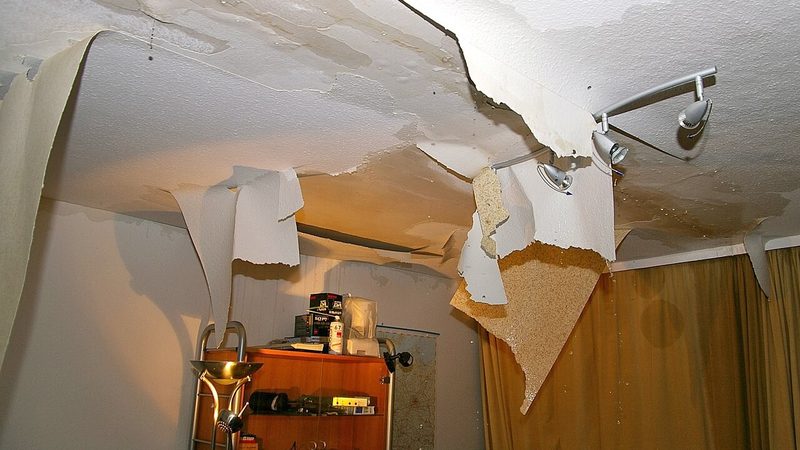
A ceiling that is sagging, bulging, or feels heavy with trapped water has lost strength and can fail with little warning. Stay out from under it, and do not poke it yourself if it looks unstable.
A small, firm, stable wet spot is a lower-urgency situation. You can drain it carefully from a step stool, never standing directly under it.
| What you see or feel | What to do |
|---|---|
| Small, firm wet spot or stain, no sagging or give when you touch it | Lower urgency. Carefully relieve a small, stable bulge with a screwdriver over a bucket, from a step stool, never directly under it. |
| Visible sagging, bulging, or a section that feels heavy or soft | Stay out from under it. Do not poke it yourself. Leave the room and call a professional right away. |
| Any creaking, cracking sound, or visible movement | Leave the room immediately. This can mean the ceiling is about to fail. |
To understand exactly how a water-soaked ceiling gives way, how a water-damaged ceiling can actually collapse covers the mechanics in more detail.
What's Actually Causing the Tub Leak Through the Ceiling, and How Do You Test for It Yourself?
The three most common causes are a leaking drain fitting, a failed overflow-drain gasket, and worn caulk or grout around the tub. A cracked tub shell or a jetted-tub pump or union is less common.
Run through the three tests below in order. They narrow down the cause without opening any walls.
Three quick tests, in order
- Caulk and grout test: run a hand along the caulk line where the tub meets the wall and floor. Gaps, cracks, or a soft, dark caulk bead point to worn caulk letting shower spray through, the easiest cause to fix yourself.
- Fill-and-watch test: plug the drain, fill the tub a few inches, and watch the ceiling below for several minutes without running water anywhere else. A drip during this test points to the drain fitting or a crack in the tub, not the overflow.
- Overflow-spray test: with the drain open, run water up to the overflow opening without filling past it, and watch below. A drip here points to a failed overflow-drain gasket.
If the leak keeps dripping even after the shower has been off for a while, it is most likely coming from a water supply pipe leaking inside the wall or subfloor, which you can learn to repair if accessible, not the drain, overflow, or caulk, according to Roto-Rooter's guide to diagnosing a ceiling leak.
Common causes at a glance
| Cause | How common | How it usually shows up |
|---|---|---|
| Worn caulk or grout at the tub edge | Most common, easiest DIY fix | Leaks mainly during or right after a shower, and the drip stops soon after the water goes off |
| Drain fitting or gasket | Common | Leaks during draining or whenever water sits in the tub |
| Overflow-drain gasket | Common | Leaks only when the tub is filled close to or past the overflow opening |
| Cracked tub shell | Less common | Leaks whenever there is standing water in the tub, in a consistent spot |
| Jetted-tub pump seal, union, or jet gasket | Only on jetted or whirlpool tubs | Leaks mainly when the jets are running, not with a plain fill |
| Supply pipe inside the wall or subfloor | Less common, more serious | The leak continues even after the shower is fully off, per Roto-Rooter |
If the drip comes from a shower wall rather than the tub, the causes and access routes differ; see how to reach a broken pipe behind a shower wall to tell which one you have.
If the stain shows up even when nobody has used the tub recently, it may not be the tub at all; see water stain on ceiling that is not from the roof for other causes like an AC condensate drain or a leak from a different fixture above.
If you want the full list of bathtub leak causes and fixes for problems beyond this ceiling scenario, we cover it in a separate guide.
Is a Leak From a Jetted or Whirlpool Tub Different?
Yes. A jetted tub has a pump, hoses, and unions that a standard tub does not, and any of these can leak, usually only while the jets are running.
Because of this, the fill-and-watch and overflow-spray tests above may show nothing even though the tub is actually leaking.
Extra failure points on a jetted or whirlpool tub
- Pump seal, where the motor connects to the plumbing
- Hose unions and clamps behind the access panel
- Individual jet gaskets around each jet body
- The access panel itself, if it is not sealed and lets shower spray behind it
Can You Fix This Yourself, or Do You Need a Licensed Plumber?
Resealing caulk or swapping an overflow or drain gasket is a reasonable weekend job with basic tools. A cracked tub shell, a jetted-tub pump or union, or a cause you cannot pin down is a job for a licensed plumber.
| Cause | Realistic to fix yourself? |
|---|---|
| Worn caulk or grout | Yes, a basic weekend job with a caulk removal tool and fresh silicone caulk |
| Overflow-drain gasket | Often yes, if you are comfortable removing the overflow plate and drain assembly |
| Drain fitting or gasket | Sometimes, depending on tub access; a plumber is recommended if the drain is hard to reach |
| Cracked tub shell | No, needs a plumber or tub specialist to assess repair versus replacement |
| Jetted-tub pump, union, or jet gasket | No, call a licensed plumber familiar with jetted tubs |
| Leak that continues after the shower is off (possible supply pipe) | No, call a licensed plumber right away |

Will Homeowners Insurance Cover a Bathtub Leak Through the Ceiling?
Usually yes, if the leak was sudden and accidental and you reported it quickly. Usually no if it was a slow drip you let run for weeks.
The Washington State Office of the Insurance Commissioner says sudden, accidental leaks are usually covered when you report them quickly and follow the insurer's fix-it instructions, while damage from a long-running, unrepaired leak usually is not.
| Situation | Usually covered? |
|---|---|
| A gasket or fitting suddenly fails and you report and fix it promptly | Usually yes |
| Caulk has been visibly failing or dripping for weeks or months before you acted | Often denied, treated as a gradual, maintainable leak |
| Your policy has a separate water-damage sublimit lower than your overall coverage | Payout may be capped well below the damage; check your own policy |
Some policies carry a lower, separate sublimit just for water damage. Washington's insurance commissioner has warned that a policy might carry a $500,000 overall maximum benefit but only a $10,000 optional sublimit for water damage.
For the fuller sudden versus gradual leak coverage rules at the pipe level, see whether homeowners insurance covers a burst pipe. This is general information, not advice on your specific policy, so confirm the details with your own insurer.
How Much Does It Cost to Fix a Bathtub Leaking Through the Ceiling?
Plan for two separate cost lines: the plumbing fix itself, and the ceiling repair. A leaking bathroom ceiling commonly runs $350 to $2,000 to repair, on top of whatever the plumbing repair costs.
| What | Typical range | Source |
|---|---|---|
| Plumbing repair (gasket, drain, or overflow assembly) | A low hundred dollars up to several hundred, depending on access and parts | General market range, no single source |
| Leaking bathroom ceiling repair (drywall, patch, paint) | $350 to $2,000 | American Family Insurance |
| General ceiling-area repair, any cause | $684 average, $300 to $1,100 range | American Family Insurance |
| Mold treatment, if the ceiling stayed wet more than 24 to 48 hours | Adds to the ceiling-repair cost above, depending on size and severity | See the mold section below |
American Family Insurance also lists broader water damage repair at $1,200 to $1,800, and burst-pipe-scale damage at $500 to $4,000 or more. For details on the costs and consequences of burst pipe water damage, see what happens when a burst pipe causes water damage. For a wider view, see how much water damage restoration typically costs.
If You Rent or Own a Condo, Whose Job Is It to Fix This?
If you rent, this is normally the landlord's repair to make within a reasonable time after you give written notice. If you own a condo, responsibility generally follows where the water came from.
If you rent
State law, not one national rule, sets how fast a landlord must fix a leak like this, so check your own state and city rather than relying on a generic day count.
In Georgia, landlords have a duty to keep rented homes safe and in good repair, and a leaky pipe qualifies as a repair the landlord must make within a reasonable opportunity after written notice, according to the state Attorney General's office. That is one real state's example, not a nationwide rule.
Give your landlord written notice, keep a copy, and photograph the damage and the date you found it, since documentation matters if the repair is delayed.
Whether renters insurance covers a leak like this mostly comes down to your own belongings and liability, not repairs to the building itself, which stay the landlord's job.
If you own a condo
In a condo, if the water came from something inside the upstairs unit itself, such as its own tub or in-unit plumbing, the unit owner is typically liable for the resulting damage.
If it came from a shared or common-element component instead, the association and its master policy are typically responsible. The Community Associations Institute's Illinois chapter explains this rule under the Illinois Condominium Property Act, though your own association's governing documents and state statute control the details.
Check both your association's rules and your own HO-6 policy before assuming who pays, since the split varies by state and by building.
How Soon Can Mold Start, and What Happens If You Just Keep Emptying a Bucket?
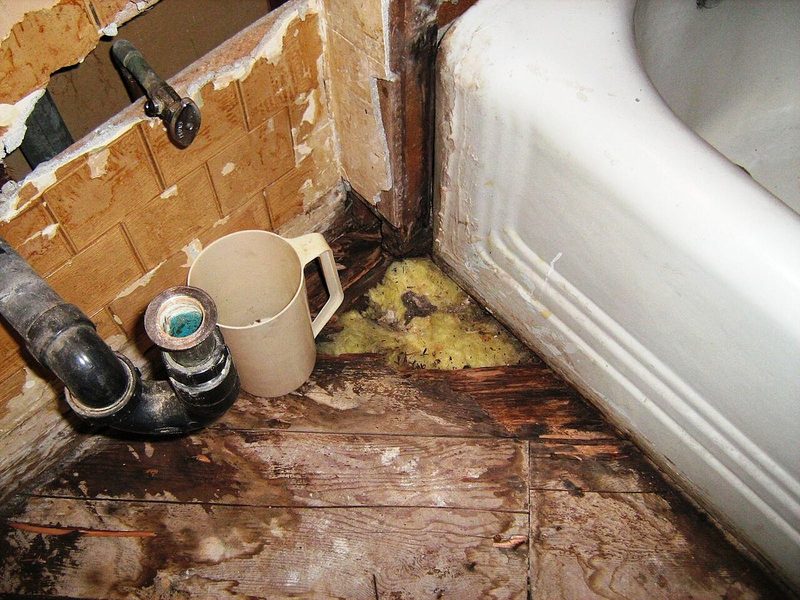
Mold can begin growing within 24 to 48 hours of the ceiling material getting wet, according to the EPA. A bucket only catches the drip; it does not stop that clock.
Left alone, the wet insulation, framing, and drywall stay damp between drips, which is exactly the setup mold needs to keep growing between showers.
The U.S. EPA's guide to mold and moisture states that drying wet materials within 24 to 48 hours of a leak usually keeps mold from growing, and recommends keeping indoor humidity below 60 percent, ideally between 30 and 50 percent.
To see exactly how that 24 to 48 hour clock plays out on wet drywall specifically, how long before wet drywall actually grows mold breaks down the timeline in more depth.
When to call a professional
Call a licensed plumber or a water damage professional right away if any of these apply:
- The ceiling below is visibly sagging, bulging, or feels heavy: leave the room and call a professional immediately, and do not poke it yourself.
- The leak keeps dripping even after the shower has been off for a while: this points to a supply pipe inside the wall or subfloor, the same kind of hidden failure covered elsewhere on this site, not the drain, overflow, or caulk.
- You cannot find or stop the source after the three tests above: call a licensed plumber rather than opening the wall or ceiling yourself.
- The wet ceiling material has already been damp for more than 24 to 48 hours: call a professional water damage or mold remediation company, per the EPA's drying benchmark.
- You have a jetted or whirlpool tub and the leak only happens when the jets run: call a licensed plumber familiar with jetted-tub pumps and unions.
- You smell sewage, see sparking outlets, or notice exposed wiring near the wet area: this is a life-safety situation. Shut off the breaker if it is safely reachable, and call a professional right away.
Frequently asked questions
How long does the whole process take, from finding the leak to a fully repaired ceiling?
There's no single confirmed number for this. Stopping the leak and testing the cause can often happen the same day. A plumber's fix is often same-day to a few days, depending on parts. The ceiling needs to dry fully, per the EPA's 24 to 48 hour window, before drywall repair and paint can start, so the whole process often stretches over one to a few weeks.
If the leak only happens while the shower is running and stops right after, does that change what's causing it?
Yes. A leak that stops when the water stops usually points to the drain, the overflow, or the caulk. A leak that keeps dripping even after the shower is off usually points to a supply pipe inside the wall or subfloor, according to Roto-Rooter, and that needs a plumber, not a caulk fix.
Could the leak actually be coming from a toilet or sink instead of the tub?
Yes, it is worth ruling out. Roto-Rooter's research on upstairs bathroom leaks names three common fixtures: a bad toilet wax ring letting water reach the subfloor, a damaged shower or tub tile, faucet, or supply pipe, and worn sink gaskets, washers, or O-rings. If the stain is spread out rather than directly under the tub, check the toilet and sink too.
What if the ceiling leak seems to have stopped on its own?
Do not assume it is fixed. Caulk and gasket leaks are often intermittent, showing up only during certain showers or fill levels. Run the three tests above before you conclude the leak stopped, and keep watching the same spot for at least a week to be sure it does not come back.
Does it matter whether my ceiling is drywall or old plaster?
Not for how you should treat it. Both drywall and plaster can sag and weaken when soaked. Plaster ceilings in older homes can be heavier and more brittle than modern drywall, so treat any sagging or bulging plaster ceiling with at least as much caution as drywall, and stay out from under it either way.
Can this cause damage even if I don't see any mold yet?
Yes. Water can warp flooring, stain paint, damage electronics or furniture below, and weaken drywall or plaster structurally, all before mold becomes visible. That is why the EPA's 24 to 48 hour drying window matters even when nothing looks moldy yet, since the damage underneath can still be spreading.
Sources
- US EPA, A Brief Guide to Mold, Moisture and Your Home
- Washington State Office of the Insurance Commissioner, Leaks, water intrusion and mold
- Washington State Office of the Insurance Commissioner, Watch out for insurance policies that limit your coverage for water damage
- U.S. Consumer Product Safety Commission, Easily Installed Device Protects Family Against Electrocution
- U.S. Consumer Product Safety Commission, Using A Portable Hair Dryer? A GFCI Could Save Your Life
- Georgia Office of the Attorney General, Consumer Protection Division, Landlord won't make repairs
- Community Associations Institute, Illinois Chapter, Liability of Condo Associations for Damages Caused by Failure of the Common Elements
- American Family Insurance, How to deal with bathroom ceiling leaks
- Roto-Rooter, Water Leaking Through Ceiling: What to Do